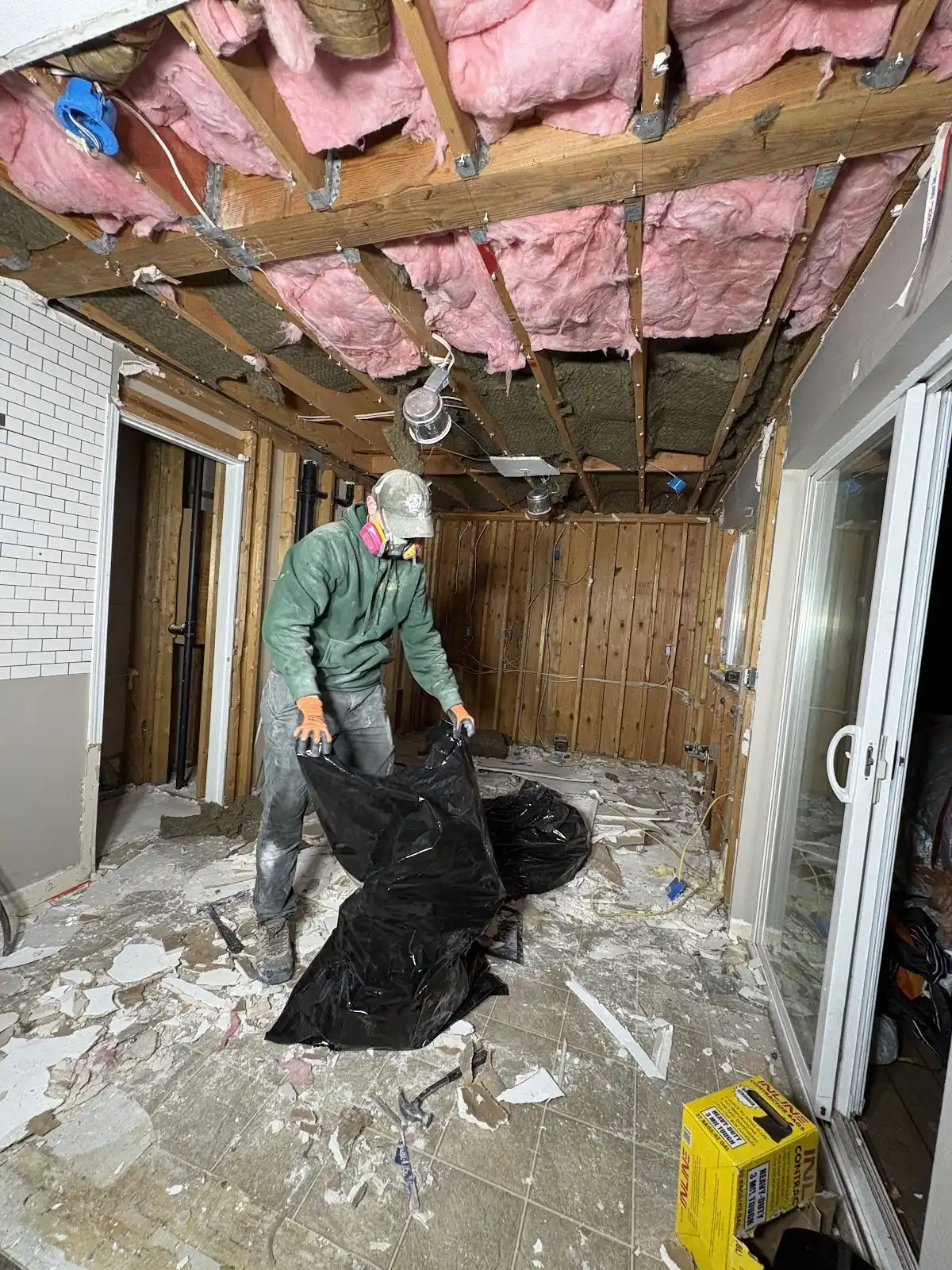
A fire-damaged house starts from the ordinary permit rules, at least on the city pages we read, which do not treat fire as a special category. Those rules start broad. The Seattle Department of Construction and Inspections (SDCI) says most projects in Seattle require a permit. The residential code calls for one before repairing, altering or demolishing a house, then lists exceptions.
This is a planning guide, not a ruling. Only SDCI can answer for your address and your damage. Bring it your questions early, with your scope in hand.
Protect the house first
None of these pages names a tarp or plywood over a window. Do not wait on paperwork to keep the rain out; emergency board-up explains that work. If protecting the house means cutting or bracing framing, call an engineer and SDCI that day.
SDCI has an emergency repair permit for a house with structural damage caused by an emergency situation. You need a letter from a structural or geotechnical engineer saying the project is an emergency. The page does not mention fire, so ask whether yours qualifies at SDCI's main number, (206) 684-8600.
What usually needs a permit
| Work | Usually needs a permit? | Office or source |
|---|---|---|
| Soot cleaning, painting | No | Listed as exempt by SDCI |
| New cabinets, surface finishes over existing walls and ceilings | No, with no envelope change | Listed as exempt by SDCI |
| Insulating existing walls and attics | No | Listed as exempt by SDCI |
| Minor repairs of $6,000 or less in six months, nothing load-bearing | Usually no | Listed as exempt by SDCI |
| Roof repair and sheathing | Ask; see below | SDCI |
| Charred joists, rafters, studs, beams or headers | Yes, plan on it | SDCI, usually with an engineer |
| Changing windows or exterior doors | Usually yes | SDCI |
| Wiring, panels and service | Yes, with few exceptions | SDCI |
| Plumbing and gas piping | Usually yes | Public Health - Seattle & King County |
| Furnace and ducts | Usually yes; ask | SDCI |
| Removing the house | Yes | SDCI and the Puget Sound Clean Air Agency |
Four things limit that "no":
- The dollar line is narrow. SDCI's page on whether you need a permit sets the $6,000 limit per six-month period, and the code rules out any removal or alteration of load-bearing support. A fire repair of any size rarely stays under it.
- Safety features. The code says egress, light, ventilation and fire resistance cannot be reduced without a permit.
- Critical areas. SDCI's exempt list applies unless you are in an environmentally critical area, such as a steep slope.
- Code still applies. SDCI says exempt work must still meet all code requirements and development standards.
The exempt list also mentions in-kind replacement of deteriorated members. Do not assume charred framing fits that wording. Ask before you rely on it.
Roofs. SDCI's page says a detached one- or two-family house does not need a permit to replace existing sheathing or repair the roof, if the building envelope does not change and the work is as good as the existing structure. The 2021 code text says permits are required for structural changes and replacement of sheathing of any size. Those read differently, so ask SDCI before a burned roof deck comes off, and keep the answer in writing.
The routes a permit can take
Subject-to-field-inspection. SDCI's Tip 316, updated October 29, 2026, covers simple projects that do not need extensive plan review, including interior alterations, foundation repair, windows and siding, and some repairs. Each one needs a signed checklist. Without an engineer's stamp, beams and headers are limited to 8 feet when supporting up to two stories, 14 feet for one story and 16 feet for garage door headers. A project that needs structural or geotechnical special inspections does not qualify.
Plan review. Larger and phased projects go this way, with drawings and often an engineer's calculations. Our rebuild timeline shows how it overlaps with scope approval.
Electrical. SDCI's electrical FAQ says you need a permit for all electrical work, with a few exceptions. A homeowner can get one if doing the work personally; otherwise you must hire an electrical contractor. Work must be inspected before it is covered, and a service must be inspected before it is energized. Heat-exposed wiring is not a weekend project. Electrical staff answer at (206) 684-8950.
Plumbing and gas. Public Health - Seattle & King County issues these permits and performs the inspections in Seattle. A homeowner's permit authorizes the homeowner to do the plumbing, but the agency recommends a professional, and a hired plumber must be a registered contractor.
If the house has to come down
SDCI says you need a demolition permit to remove housing, and that housing may be demolished only in listed cases. These include an owner-occupied house, one not used as a rental in the last six months and one under an unfit-for-habitation order. A rental deserves an early call.
- Rats. The application needs a declaration of at least 15 days of rat abatement right before work starts, by a licensed pest control company.
- Asbestos. You must meet the survey requirements before you can get the permit. For demolition, the Puget Sound Clean Air Agency requires an AHERA-certified inspector and a notification with a filing fee. You must wait 10 days after filing, whether or not any asbestos is involved. Neither page mentions a fire exception, so call the agency at (206) 343-8800.
- Remodels. For a house being repaired rather than demolished, an owner-occupant may survey it personally. Anyone you hire will want the result.
Before anything comes down, also ask SDCI whether the old footprint can be rebuilt as it stands if the house is closer to a lot line than today's rules allow. In a Seattle landmark district such as Harvard-Belmont, exterior work may need a separate approval from the Department of Neighborhoods.
Step by step: getting started before the rebuild
- Confirm the city. The permit office goes by city limits. A Seattle mailing address does not settle it near the edges.
- Mark up the scope. Ask your contractor to mark each line as permit or no permit, using the table above as a start. Fire damage assessment and estimates explains how scopes get written.
- Get the framing looked at. If anything load-bearing is charred or sagging, read when to hire a structural engineer.
- Survey before you demolish. Do the asbestos work first, and treat paint from before 1978 as possibly containing lead.
- Find the old paperwork. Gather plans, old permits and remodel records. They speed up drawings and show what was legal before the fire.
- Decide who applies, in writing. Most contractors pull the permits and book inspections. Check the registration with L&I's verification tool, and ask to see the permit before work starts.
- Ask SDCI which route fits. Register for an account in the Seattle Services Portal, and ask about a pre-application if the scope is large.
- Inspect before you close up. Do not let drywall cover framing or wiring until it has passed. Keep every inspection record for your insurer and a future buyer.
Typical costs around Seattle
These are typical Puget Sound ranges for planning, not quotes. SDCI's emergency repair page says its fees are based on your estimated value of work, labor and materials, plus a technology fee, so a larger scope pays more. Ask SDCI for a fee statement.
- A trade permit: commonly in the low hundreds of dollars each.
- Field-inspection building permit for a smaller repair: commonly several hundred dollars to a couple of thousand.
- Plan-review permit for a larger rebuild: commonly a few thousand dollars or more.
- Engineer's site visit and letter: commonly $500 to $1,500. Repair drawings commonly run $2,500 to $10,000 or more.
- Asbestos survey: commonly a few hundred dollars and up.
- Rat abatement: commonly a few hundred dollars.
A larger rebuild can also bring parts of the house up to current code. Our guide on fire rebuild cost and who pays explains how ordinance-or-law coverage fits. For restoration work, the terms are $0 upfront on covered claims - insurer billed directly - deductible applies.
When to call a professional
Get help when:
- Framing is charred or sagging, or you are being asked to choose between repair and rebuild with no evaluation.
- Someone offers to skip the permit. Unpermitted work can surface at the next sale or claim.
- An official has posted the house, or an inspector has stopped the work.
- The scope covers structure and several trades. Fire damage repair and reconstruction shows how one contractor handles the permits and inspections.
Estimators work across King County and the rest of Puget Sound and will tell you plainly what your scope needs. Call (425) 279-7097.